Crypto Card Fees in 2026: Every Fee Compared, Card by Card
The fees that decide what a crypto card really costs are the foreign-exchange fee, ATM charges past a free allowance, top-up and subscription costs, inactivity fees, and the conversion spread taken whenever your crypto is sold to pay. Card by card they vary enormously: on 9–10 Oct 2026 the FX fee ranged from 0% on the Gemini Credit Card and the Coinbase One Card to 3% on Crypto.com's lower US tiers, and ATM fees from free allowances of up to €2,000 a month to 2% on every withdrawal.
The cashback banner shows none of this, so the number to compare is what you keep after fees. Below is a dated fee matrix for the main cards, a worked month-abroad example in euros and in dollars, and the cost that no schedule itemises. Everything is taken from issuers' own pages, read on the dates shown; fees change, so recheck before you apply. This is education, not financial advice.
The five fees, and where they hide
Each fee attaches to a different action, which is why they slip past one at a time. Read the issuer's fee schedule, not the marketing page, and look for these five.
| Fee | What it is | When it applies | How to limit it |
|---|---|---|---|
| FX fee | A % added to spending in a currency other than the card's | Purchases abroad or from foreign merchants | Pick a 0% FX card or a tier that waives it |
| ATM fee | A % or minimum charge once a free monthly allowance is used | Cash withdrawals | Fewer, larger withdrawals inside the allowance |
| Top-up / plan fee | A charge to load the card, or a monthly tier subscription | Funding by card or PayPal; paid tiers | Fund from a free method; pay for a tier only if it pays back |
| Inactivity fee | A monthly charge on a dormant card | Usually after 12 months without use | Use the card or close it |
| Conversion spread | The gap between the rate you get and the market rate | Every crypto-funded purchase | Spend fiat or a stablecoin balance |
Fee matrix: the main cards compared (dated)
The table splits US and European cards because the products differ by region. Crypto.com, for example, sells a Visa Signature credit card in the US, a prepaid card in the US and a different prepaid card in Europe, each with its own schedule. Where a figure is missing, the issuer's card page did not state it when we read it, so we leave it blank rather than guess.
| Card | Type, region | Plan or annual cost | FX fee | ATM | Other |
|---|---|---|---|---|---|
| Crypto.com Visa Signature | Credit, US | $0 annual; Plus $4.99/mo | 3% | Cash advance $10 or 5% | APR 17.49%/25.49%/31.49%; late fee up to $41 |
| Crypto.com prepaid Visa | Prepaid, US | $0, $4.99 or $29.99/mo, or a CRO stake | 3% lower tiers; 0% Icy, Rose, Obsidian | Free $200–$1,000/mo, then 2% | Top-up 1% debit, 2.99% credit, 2.1% PayPal; $5.95/mo after 12 months idle |
| Crypto.com prepaid | Prepaid, Europe | €0, €3.99 or €24.99/mo, or a CRO stake | Midnight 0.2% EU/UK, 2% outside; Ruby/Jade free outside EU/UK to €400/€800, then 2% | Free €200–€1,000/mo, then 2% | Card top-up 1%; €6/mo after 12 months idle |
| Nexo Card | Credit or debit mode, EEA/UK | No monthly, annual or inactivity fee | 0.2% weekdays, 0.7% weekends in EEA/UK/CH; 2%/2.5% elsewhere | Free €200–€2,000/mo by tier, then 2% (min €1.99) | Credit Mode interest from 1.9%/yr |
| Bitpanda Card | Debit, euro area | No monthly cost | €0 Bitpanda fee; Visa's rate applies | 2% or €2, whichever is higher | 1% cashback on crypto spending only |
| Coinbase One Card | Credit, US | $0 card fee; Coinbase One from $49.99/yr | $0 | Cash advance $10 or 5% | APR 19.49%–29.49%; late fee up to $41 |
| Gemini Credit Card | Credit, US | $0 annual | $0 | APR not shown on card page | |
| Coinbase Card | Prepaid debit, US | $0 annual | No spending fee; spread on crypto conversion |
Sources: crypto.com/us/cards, Comenity's Crypto.com card disclosure, help.crypto.com US and Europe fee articles, nexo.com/nexo-card, bitpanda.com/en/card, the Coinbase One Card cardholder agreement, coinbase.com/creditcard, coinbase.com/card and gemini.com/credit-card. Crypto.com's European FX schedule changed on 1 Oct 2026, so older reviews that say Ruby and above pay no FX anywhere are out of date.
The FX markup is the biggest silent cost
For anyone who spends abroad or with foreign online shops, the FX fee usually outweighs every other charge, because it applies to each purchase rather than once. The split in the matrix is stark. Two US credit cards, Gemini's and the Coinbase One Card, charge no FX fee, while Crypto.com's US credit card and its lower prepaid tiers charge 3%. In Europe, Nexo charges 0.2% on weekdays inside the EEA, UK and Switzerland, but 2.5% on a weekend outside them. Bitpanda charges no FX fee of its own, but its page says Visa's mark-up applies, so the exchange rate itself carries a margin you cannot see in advance.
Tiers matter here too. Crypto.com's top US prepaid tiers remove the 3% FX fee, but they require $50,000 or more of CRO locked for 12 months, a stake that can fall in value while it is locked. That trade is covered in staking to unlock card tiers, and it rarely pays for FX savings alone.
Crypto card ATM withdrawal fees
ATM charges follow one of two patterns. Crypto.com and Nexo give a free monthly allowance that rises with your tier, from €200 or $200 at the bottom to €1,000, $1,000 or, at Nexo Platinum, €2,000, and then charge 2% per withdrawal; Nexo sets a €1.99 minimum. Bitpanda has no allowance on its fee table: each withdrawal costs 2% or €2, whichever is higher, which makes a €50 withdrawal cost 4% in effect. On the US credit cards, cash from an ATM is a cash advance, with a $10 or 5% fee and a higher APR from day one, so it is the most expensive cash of all.
Local banks can add their own ATM charge on top, which no card can waive. The practical rule is the same everywhere: take fewer, larger withdrawals inside the free allowance, and never use a credit card for cash.
The conversion spread you never see itemised
The conversion spread is the hardest cost to spot because it is built into the exchange rate rather than shown as a line. When a card sells your crypto to fund a purchase, the price you get is slightly worse than the market price, and the provider keeps the difference. Coinbase says it plainly in its card footnote: there are no Coinbase transaction fees, but a spread applies when it buys, sells or converts crypto. None of the issuers we checked publishes the size of that spread on its card page.
There are two ways to shrink it. Spend a fiat or fiat-backed balance, which needs no crypto sale, or spend a stablecoin, whose price barely moves. Both also sidestep the tax issue below, at least for the fiat balance, because a purchase funded by crypto is a sale of crypto.
Worked example: a month of travel spend
Fee schedules mean little until they meet real spending, so here are two scenarios built only from the published figures above. Neither includes cashback, the conversion spread, or local ATM operators' charges, and both count a monthly tier subscription as part of the cost.
An EEA cardholder spending a month in the US
Assume €1,500 of purchases in dollars on weekdays, plus two €200 cash withdrawals. We apply the FX fee to purchases and the ATM fee to cash; if a card also adds FX to foreign cash, its total rises.
- Crypto.com Midnight (free): 2% FX on €1,500 is €30; the first €200 of cash is free and the second costs €4. Total €34.
- Crypto.com Ruby (€3.99/month): FX is free on the first €400, then 2% on €1,100 is €22; cash is inside the €400 allowance. Total €25.99.
- Crypto.com Jade (€24.99/month): 2% on €700 above the €800 free band is €14, cash is free, but the plan costs €24.99. Total €38.99.
- Nexo Card, Base tier: 2% weekday FX outside Europe is €30; the second withdrawal costs €4. Total €34. Nexo lists this €200 Base cash allowance, though it now issues physical cards only from Gold tier.
- Nexo Card, Gold tier: the same €30 of FX, with both withdrawals inside the €1,000 allowance. Total €30.
- Bitpanda Card: no Bitpanda FX fee, two withdrawals at €4 each. Total €8, plus whatever margin Visa's exchange rate carries.
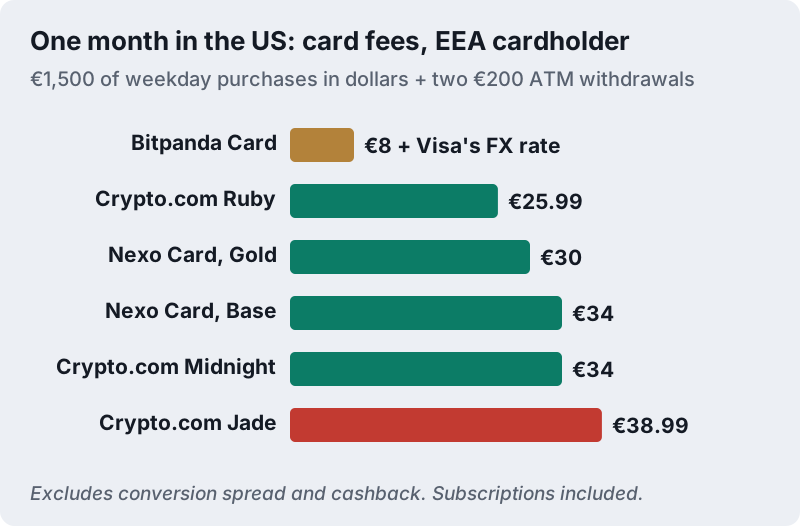
Paying for a higher Crypto.com tier only to save FX does not pay back at this spend: Jade costs more than Midnight. Bitpanda looks cheapest, but its total hides Visa's rate, so compare the euro amount charged against the day's market rate on your first purchase. And remember that Nexo's lower FX applies inside Europe; on this US trip it is 2%.
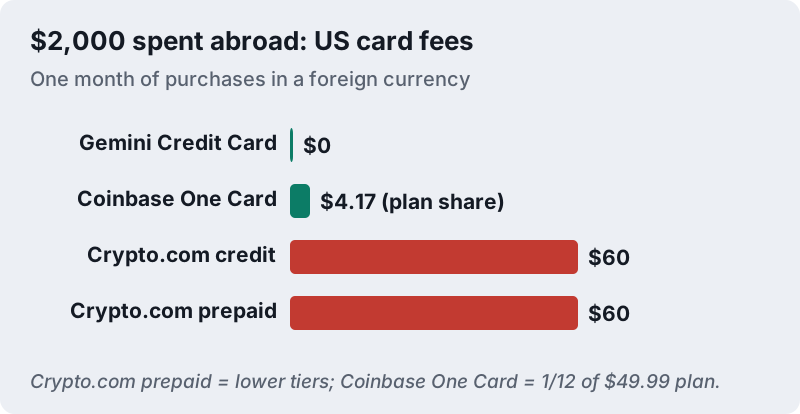
A US cardholder spending $2,000 abroad
For a US cardholder the question is mostly the FX fee. On $2,000 of foreign purchases, Crypto.com's US credit card and its lower prepaid tiers each charge 3%, or $60. The Gemini Credit Card and the Coinbase One Card charge no FX fee, though the Coinbase card needs a Coinbase One membership from $49.99 a year, about $4.17 a month.
Top-up, monthly and inactivity fees
Loading costs bite on prepaid cards. Crypto.com's US prepaid card charges 1% to top up by debit card, 2.99% by credit card and 2.1% via PayPal; in Europe a card top-up costs 1%. Funding from a crypto or fiat balance already held with the issuer avoids that charge, though crypto funding brings back the spread. Tier subscriptions are the other recurring cost: Crypto.com's Ruby plan is $4.99 or €3.99 a month and Jade $29.99 or €24.99, and the Coinbase One Card needs a Coinbase One plan.
Inactivity fees are rare but real. Crypto.com's US prepaid card charges $5.95 a month after 12 months without activity (from 1 Sep 2026), and its European card €6 a month (from 1 Oct 2026). A forgotten card with a small balance can drain it. Nexo states no inactivity fee, and Bitpanda lists no monthly cost.
The tax cost of a crypto-funded swipe
A fee schedule never mentions the cost that can outweigh all the others: tax. Under IRS rules, digital assets count as property, and HMRC lists paying for goods or services with cryptoassets as a disposal, so each purchase funded by crypto can be a capital-gains event you must record. Bitpanda's own FAQ says paying with crypto usually triggers a taxable event, while paying from its euro wallet does not. Credit cards avoid this at the till because you repay in cash. Our crypto card taxes guide covers the mechanics; none of this is tax advice.
Calculating the rate you actually keep
To compare cards fairly, start with the cashback at the tier you will really hold, then subtract the fees your spending triggers: FX on your foreign share, ATM charges for your cash habits, top-ups, any plan fee and an allowance for the spread. Then discount any reward paid in a volatile token for the risk it falls before you sell. Run the same sum for an ordinary cashback card, whose reward needs no discount and whose spending creates no crypto sale, and the comparison in crypto card vs selling to your bank often favours the plain card.
How to cut crypto card fees
- Match the card to where you spend: a 0% FX card for travel outside your home currency, a low-FX European card for spending inside Europe.
- Fund purchases from fiat or a stablecoin to avoid the spread and, for fiat, the crypto sale.
- Stay inside the free ATM allowance, and never take cash on a credit card.
- Pay for a tier only if the sum above shows it pays back at your real spend.
- Close cards you no longer use before an inactivity fee starts.
If your spending is mostly in Europe, Nexo and Bitpanda charge no monthly card fee and, in our example, cost no more than Crypto.com's free tier, with different trade-offs: Nexo's cashback needs Credit Mode and a $5,000 balance, while Bitpanda charges on every ATM withdrawal. For US spenders who want Crypto.com's ecosystem, Crypto.com is the keyed option here, but its 3% FX fee makes it a poor travel card below the top tiers. We may earn a commission from these links; it does not change the numbers. Our best crypto card for travel and best crypto cards pages go further.
Crypto card fees: FAQ
What fees do crypto cards charge?
What is the crypto card ATM withdrawal fee?
Does the Coinbase debit card have fees?
Which crypto card has no foreign transaction fee?
How do I avoid crypto card fees?
New here? Start with the best crypto cards, gauged on rewards, fees and the staking catch, or read how crypto cards actually work.