Coinbase One Card vs Coinbase Card: Rewards, Fees and Catches
The Coinbase One Card is the better of the two Coinbase cards only if you already pay for an annual Coinbase One plan and clear your balance in full every month. It is an American Express credit card that pays 2% to 4% back in bitcoin, but you must hold a paid Coinbase One membership to open it and to keep it. The Coinbase Card is a different product altogether: a Visa prepaid debit card with no annual fee and no credit check, which spends dollars or sells your crypto at the till for a variable, rotating reward.
Skip the One Card if you sometimes carry a balance, because its purchase APR runs from 19.49% to 29.49%, or if you would be buying the membership only to get the card. Skip the debit card if you plan to fund it with volatile crypto and have no appetite for recording a taxable sale on every purchase. Everything below was read on Coinbase's own pages and the card's cardholder agreement on 9 and 10 Oct 2026, and the terms change, so confirm them in the app before you apply.
The short answer, card by card
Think of the two cards as answers to different questions. The One Card asks: would you like to turn ordinary spending into bitcoin, on credit, in exchange for a membership fee? The Coinbase Card asks: would you like to spend money that already sits in your Coinbase account, whether that is cash or crypto? The first is a rewards credit card with a crypto payout; the second is a spending tool for an exchange balance. Comparing their headline reward rates misses the point, because what each costs you is so different.
| Coinbase One Card | Coinbase Card | |
|---|---|---|
| Type | Credit card, American Express network | Visa prepaid debit card |
| Issuer | First Electronic Bank (program run with Cardless) | Pathward, N.A. |
| Who can get it | US only (not US territories), credit approval | Coinbase customers in the US except Hawaii |
| Required membership | Paid Coinbase One; Basic needs the annual plan | None |
| Membership cost | Basic $49.99/yr; Preferred $299.99/yr; Premium $2,999.99/yr | n/a |
| Card annual fee | $0 while membership is active | $0 |
| Rewards | 2%, 2.5%, 3% or 4% back in bitcoin by assets on Coinbase | Rotating crypto rewards, variable rate shown in app |
| Reward cap | Boosted tiers on $10,000/month combined, then 2% | Not stated on the card page |
| Purchase APR | 19.49%–29.49% variable | None (no borrowing) |
| Foreign transaction fee | $0 | Not stated on the card page |
| Spending fee | None listed | No spending fee; a spread applies when crypto is converted |
| Tax on spending | Paying a card bill in dollars is not a crypto sale | Spending crypto other than USD/USDC is a taxable sale, per Coinbase |
Two rows deserve emphasis because they are where most comparisons go wrong. The One Card's "no annual fee" is true only while you hold an eligible, paid Coinbase One membership; the card agreement effective 11 May 2026 says that if the membership lapses or is downgraded, the card can be suspended and then closed, and rewards may be forfeited. The membership is the card's real annual fee. On the debit side, "no spending fees" is also true as written, but Coinbase's own footnote adds that a spread applies whenever it buys or sells crypto for you, so a crypto-funded swipe is not free even when no fee line appears.
Coinbase One Card: the credit card that needs a membership
The One Card is issued by First Electronic Bank under licence from American Express and is managed in the Coinbase app, with the card program run by Cardless. Coinbase says it launched in 2025, and its Q4 2025 shareholder letter reported close to $800 million of cumulative card spend by the end of that quarter. It is a metal card on the Amex network, which means Amex-network benefits such as retail and return protection appear on Coinbase's own list, subject to their own terms.
How the bitcoin reward ladder works
Every cardholder earns bitcoin back on eligible purchases at one of four rates: 2%, 2.5%, 3% or 4%. Which one you get depends on your "Assets on Coinbase", and Coinbase says any asset counts, including USD and USDC. For the first 60 days your tier follows your real-time balance at the moment of each purchase; after that it uses the average of your end-of-day balances over the previous 30 days. The three boosted tiers apply to a combined $10,000 of eligible purchases per calendar month, and spending above that earns 2% for the rest of the month.
What the card page does not show is the asset level needed for each tier. Some outlets have published thresholds, but we could not confirm them on a Coinbase page, so we leave them out. Check the tier the app shows you before you count on anything above 2%. Bookings through the Coinbase One Card Travel portal earn a flat 5% in bitcoin instead of the tier rate, with the travel itself fulfilled by a third party that Coinbase and the issuer disclaim.
Membership, APR and fees, as disclosed
Coinbase One costs $49.99 a year on the Basic annual plan, which is the cheapest route to the card, because Basic billed monthly does not qualify. Preferred is $299.99 a year and Premium $2,999.99 a year, and every tier renews automatically. The cardholder agreement lists a variable purchase APR of 19.49% to 29.49% depending on creditworthiness, a cash-advance APR of 32.24%, a cash-advance fee of $10 or 5% (whichever is greater), late and returned-payment fees of up to $41, and no foreign transaction fee. Cash advances, cash equivalents and gambling earn no bitcoin.
Two smaller terms matter more than they look. If a purchase that earned bitcoin is refunded, the card charges back a "Rewards Adjustment Charge" equal to the dollar value of that bitcoin when it was credited, even if bitcoin has since fallen. And if you are declined, Coinbase may offer a secured version backed by a USDC deposit of as little as $100; that USDC cannot be traded, withdrawn or moved while it secures the card.
Coinbase Card: the debit card that sells your crypto
The Coinbase Card is a Visa prepaid debit card issued by Pathward, N.A. and powered by Marqeta. It is open to Coinbase customers in every US state except Hawaii, needs no credit check and no staking, and Coinbase lists no annual fee and no spending fee. You choose what pays for each purchase: dollars, USDC or another crypto asset held in your account. When the source is crypto, Coinbase converts it to dollars at the moment of purchase or ATM withdrawal, and a spread is built into that conversion.
Rewards are optional, US-only and rotate: you pick from a list of crypto assets to earn, and the rate is variable, shown in the app rather than on the public page. Because nothing is borrowed, there is no APR and no credit line to manage, which makes this the simpler card for someone who wants to spend an exchange balance and nothing more. The trade-off is that the reward rate is not published as a fixed number, so it is not something to plan around.
A plain bank debit card spends money you already hold, so there is nothing to tax. A crypto card spends an asset — which is why record-keeping matters. This is educational, not tax advice; rules differ by country.
Net reward after the membership: a worked example at three spend levels
The fair way to price the One Card is to subtract the membership from the reward. The sum below uses the cheapest qualifying plan, Basic at $49.99 a year, and counts the full fee against the card even though the plan has other benefits. It values each reward at the moment it is credited, which is the only value you can be sure of. All three spend levels stay inside the $10,000 monthly cap, so the tier rate applies to every dollar.
- $500 a month ($6,000 a year): 2% earns $120, so $70.01 net; 4% earns $240, so $190.01 net.
- $1,500 a month ($18,000 a year): 2% earns $360, so $310.01 net; 4% earns $720, so $670.01 net.
- $3,000 a month ($36,000 a year): 2% earns $720, so $670.01 net; 4% earns $1,440, so $1,390.01 net.
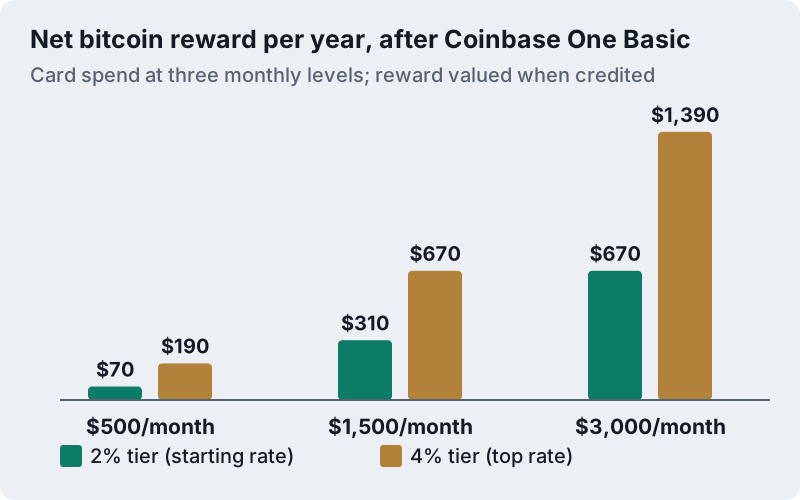
The break-even point is simple: at the 2% starting rate, the first $2,500 of yearly spend only pays back the Basic fee. Below roughly $210 a month, you are paying more for the membership than the card returns, unless you value the plan's other benefits for their own sake. The 4% column needs a large balance parked on Coinbase, which carries its own custody risk, so for most readers the green bars are the realistic ones.
What volatility does to those numbers
These figures are dollar values on the day each reward lands. Suppose you earned $360 of bitcoin over a year and bitcoin then fell 30% before you sold: the reward would be worth $252, and your net after the fee would drop from $310.01 to $202.01. The reverse can happen too, which is the point: the reward is a position in a volatile asset, not cash back. The refund clawback makes this sharper, because a refunded purchase is charged at the reward's original dollar value even if the bitcoin you were credited is now worth less.
Taxes: spending crypto is a disposal
The US tax line runs between the two cards. For federal tax the IRS views digital assets as property, so selling, exchanging or spending them is a disposal that may create a capital gain or loss reported on Form 8949. Coinbase states the same point for its debit card: spending crypto other than USD or USDC involves selling it and is a taxable transaction. Fund the debit card with bitcoin bought at a lower price and every coffee is a small realised gain. Fund it with dollars and there is no crypto sale at all.
The One Card works the other way round: you pay the bill in dollars, so purchases sell nothing. Coinbase says the bitcoin rewards are not reported on the 1099 forms it generates and that selling them later may be taxable. How the reward itself is treated when you receive it is a question to settle with a tax professional; our crypto card taxes guide explains the general mechanics. None of this is tax advice.
Who should get either card, or neither
Match the card to how you already behave with money rather than to the headline rate. The flow below captures the two questions that decide most cases, and the list after it covers the rest.
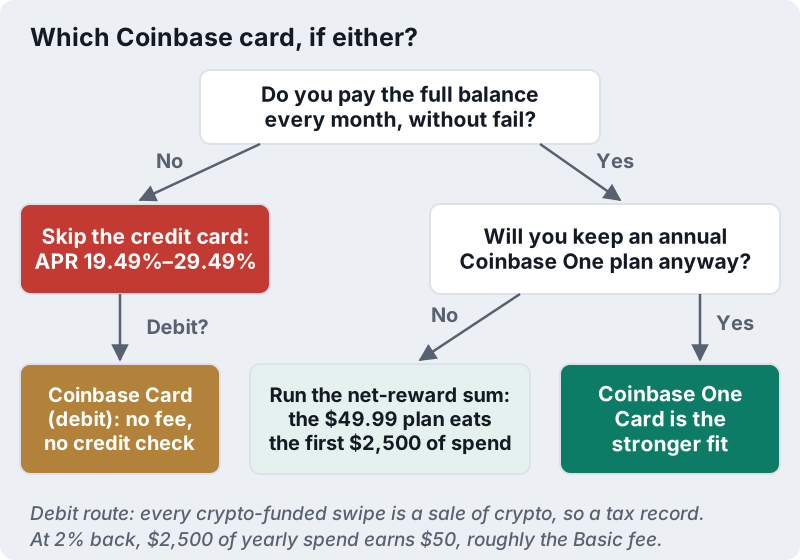
- Get the One Card if you already pay for Coinbase One on an annual plan, pay your statement in full, and want bitcoin rather than cash as a reward, knowing it can fall.
- Get the Coinbase Card if you keep a dollar or USDC balance on Coinbase and want to spend it directly, with no credit check, no membership and no borrowing.
- Get neither if you carry a balance, if your spending is low enough that the membership costs more than the reward, or if you live in Hawaii or a US territory, where one or both cards are not offered.
If you are weighing a crypto card against an ordinary rewards card, the honest benchmark is a card whose reward needs no membership and creates no tax record. Our debit vs credit crypto cards guide sets out that trade-off, and the best crypto cards page compares the wider field.
Edge cases and what can go wrong
- Your membership lapses. Cancel Coinbase One or let a payment fail, and the agreement allows the card to be suspended and closed, with unredeemed rewards at risk. Put the renewal date in your calendar.
- Your tier drops mid-month. After the first 60 days the tier uses a 30-day average balance, so moving assets off Coinbase lowers your rate gradually, not instantly.
- You return an expensive purchase. The clawback charges the reward's original dollar value to your card, added to that cycle's minimum payment.
- You spend abroad on the debit card. Coinbase's card page does not state a foreign transaction fee for the debit card, so check the cardholder agreement before a trip; the One Card lists $0.
- You bank the reward on Coinbase. Leaving bitcoin rewards on the exchange keeps them in custody; whether that suits you is a separate decision from choosing a card.
The debit card's conversion also has a practical edge: if the crypto you chose as the funding source runs short, a purchase can fail at the till. Keep a dollar or USDC balance as a buffer if you rely on the card day to day, and read how crypto cards work if the funding logic is new to you.
Coinbase cards: FAQ
Do I need Coinbase One to get the Coinbase One Card?
Is the Coinbase card a debit or a credit card?
How much bitcoin back does the Coinbase One Card pay?
Does the Coinbase debit card have fees?
Is spending with the Coinbase Card taxable?
New here? Start with the best crypto cards, gauged on rewards, fees and the staking catch, or read how crypto cards actually work.